Payment Device Controller
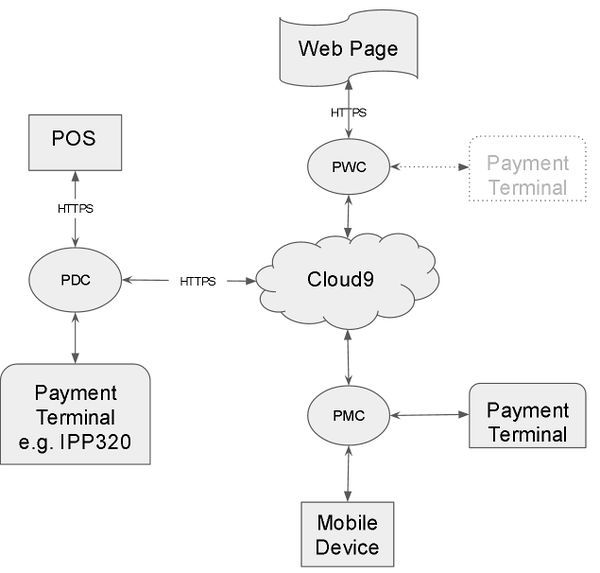
The optional Payment Device Controller (PDC) hides the complexity of low-level communications with payment terminals and adds Offline Store & Forward functionality.
Variations of the Payment Device Controller include:
- Payment Device Controller (PDC) — local software for in-store terminal communication
- Payment Mobile Controller (PMC) — mobile-based payment processing
- Payment Web Controller (PWC) — web/cloud-based payment processing
Option 1: Local PDC with Store & Forward
Clients communicate with a local Payment Device Controller through SOAP, JSON, or wizard-like wrappers written in C/C++/Java. The PDC manages terminal communication locally and provides offline store-and-forward capability — transactions are queued when connectivity drops and settled automatically when the connection returns.
Option 2: Direct Cloud Connection (PWC)
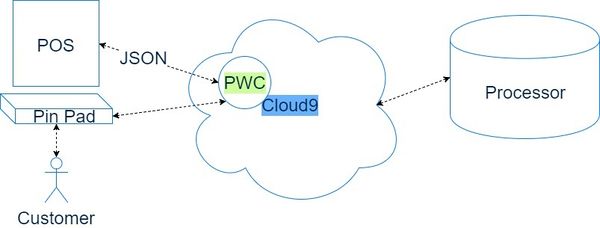
Clients communicate directly with the cloud-based Payment Web Controller (PWC) via SOAP, JSON, or wizard-like wrappers written in C/C++/Java. No local software installation is required — the PWC handles all terminal communication from the cloud.
Payment Device Controller Setup
For detailed hardware configuration and installation steps, refer to the Cloud9 Payment Device Controller Setup documentation provided during onboarding.